Monday, April 14, 2014

Thursday, March 13, 2014
Bird feeder Activity
WINTER IN THE GARDEN
Bird Feeder Activity Day February 15, 2014
 | |||
| DIY bird feeder made out of toilet paper rolls and garden twine | . |
 |
| Hanging edible bird feeders. Each was made with a birdseed/flour mixture and left to harden. |
 |
| Volunteers making popcorn garland to hang in the trees and bushes. |
 |
| Volunteer rolling the toilet paper roll in birdseed after covering with shortening. |
 |
| Bernardo hanging an abstract bird feeder. |
 |
| Bird feeders in the bushes. |
 |
| Garden teepee covered with bird feeders. |
 |
| Orange peel bird feeder. |
Saturday, February 8, 2014
Celebrate the Great Maine Outdoor weekend with us!
Bring your family to enjoy the outdoors and connect with nature this winter right here at the Topsham Public Library...
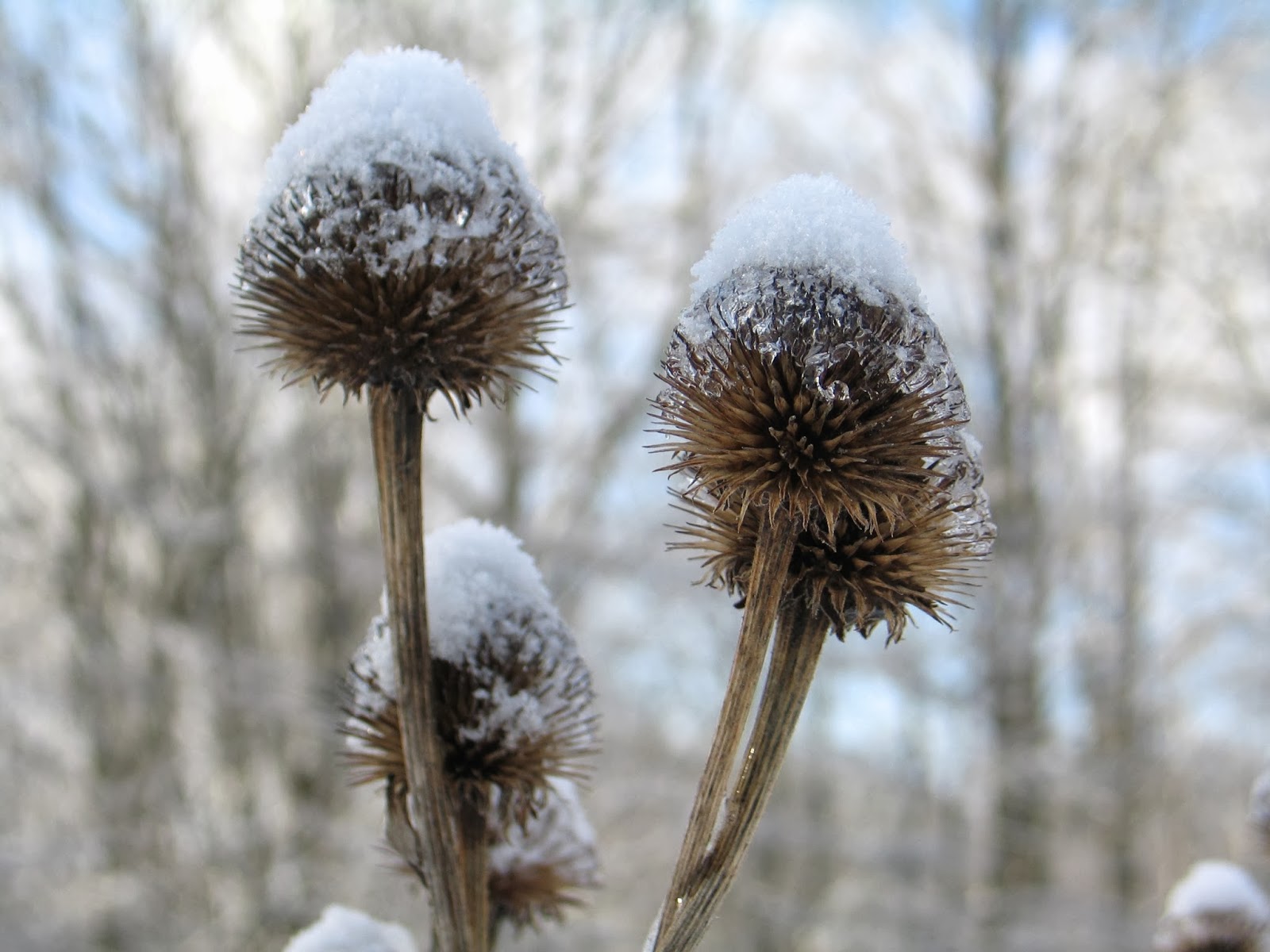
Saturday, February 14th-16th is the Great Maine Outdoor Weekend and we are hosting two events on Saturday the 15th:

Saturday, February 14th-16th is the Great Maine Outdoor Weekend and we are hosting two events on Saturday the 15th:
- From 9:15 on will be a hands-on exploration and identification of the trees along the library's paths using a camera and the Trees of Maine guide.
- Starting at 10:00am will be a DIY bird feeder activity, perfect to honor National Bird Feeding month. Choose from several feeder options. When you are through, head outside to hang them up throughout the library's gardens and paths and have fun exploring.
We look forward to seeing you then!
Wednesday, January 29, 2014
National Seed Swap Day

Did you know that there is a National Seed Swap day? There is! It's the last Saturday of January every year. Check out this link to learn more:
National Seed Swap Day

Although the date has come and gone, it's never too late to do a little seed swapping. If you're ready for some spring-time fun and would like to organize your own seed swapping party, you might like to check out this book:
Seedswap: The Gardener's Guide to Saving and Swapping Seeds by Josie Jeffery
There are also some PDFs from the book that you can download:
Seed Saving Techniques & Creating a Seed Bank
If you do host a seed swapping party, we'd love to hear about it!
Monday, January 6, 2014
Winter Garden Fun
Are you finding yourself longing for green garden views during these cold and snowy Maine days? There's no reason why your garden can't be a fun and inviting space during the winter months.
We've put together a collection of fun ideas to help overcome the winter doldrums.




Enjoy! If you try some of these ideas, stop by and let us know how it turned out...
We've put together a collection of fun ideas to help overcome the winter doldrums.
Build Snow Animals: The National Wildlife Federation Kids has some ideas with easy instructions. If you'd like to feed feathered friends at the same time, decorate your snow animal with berries, bird seed, and other bird delicacies.
Snow Painting: Color some water with food coloring and use spray bottles or ketchup-type squirt bottles to decorate the snow.
Create snow land art Andy Goldsworthy style
Cover the garden with greenery snowflakes
Enjoy! If you try some of these ideas, stop by and let us know how it turned out...
Thursday, September 19, 2013
This past Saturday, Bernardo and I spent more time trying to distinguish between American and Oriental Bittersweet than actually ridding the garden of it. Needless to say, we left most of it in place but pulled some down off of of a small tree to prevent any future harm, and to provide an up-close photo for you viewers to help us identify.


Oriental Bittersweet (Celastrus orbiculatus) is an aggressive and invasive climbing deciduous woody vine. The leaves are difficult to identify because they are extremely variable, so should not be relied upon for identification. The leaves can be round to oblong in shape and appear as alternate, simple with bluntly toothed margins. Oriental Bittersweet propagates by seed and produces greenish white flowers in the spring. In the autumn, red berries are enclosed in yellow capsules. Oriental Bittersweet grows in thickets and can strangle trees and shrubs by entangling their stems.

American Bittersweet (Celastrus scandens L.) is native to Maine. It is also a climbing deciduous woody vine but is not nearly as aggressive as Oriental Bittersweet. American Bittersweet produces red berries but they are enclosed in orange capsules and appear only at the terminal ends of the stems, whereas on Oriental Bittersweet, berries and flowers can be found all along the stem at leaf axils.

Wednesday, August 28, 2013
Horseweed
HORSEWEED
I spent a little over an hour on Saturday pulling just one type of weed from the birdsong garden. The weather was beautiful and there was a pleasant wind which made weeding less a chore. This is a common weed known as Horseweed and can grow in almost any area of your garden. The weed can grow as tall as 2 meters, well taller than myself, and reproduces by seed. The seeds germinate in late summer or early spring.


The good thing about these weeds is that they have extremely shallow root systems
and you can pull them out quite easily.
Below, find additional photos of the Garden
 |
| The Birdsong Garden |

 |
| The new Teepee |
 |
| A view from the new Teepee |
 |
| Ornamental Grasses flowing in the wind |
Monday, August 5, 2013
Secret Life of Insects
See what's buzzing at the Topsham Public Library
Click the images to see closeups.
 |
| Butterfly on purple liatris |
 |
| Bumblebee on white liatris |
 |
| Moth hiding in a yellow lily |
 |
| Great Golden Digger Wasps and a Japanese Beetle share a Purple Globe Thistle |
 |
| Japanese Beetle on purple coneflower (Echinacea) |


Bumblebees on purple coneflowers (Echinacea)
 |
| Tandem Thread Waisted Wasps |
 |
| These two were very camera shy! |
 |
| Bumblebee and Great Golden Digger Wasp |


The black ant in the left photo is eating the sugary coating that surrounds the bud. The bud will eventually bloom to the flower in the right photo.
 |
| The Twice Stabbed Stink Bug on lamb's ear is about to make the leap! |

Sunday, July 14, 2013
Patterns in Nature
The patterns that can be found in nature are just amazing. Here's a quick video to give you a sense...
Would you like to find out what patterns you can discover? Join us on the 20th at 1pm for the last in our nature journaling series: Patterns in Nature.
Hope to see you then!
Would you like to find out what patterns you can discover? Join us on the 20th at 1pm for the last in our nature journaling series: Patterns in Nature.
Hope to see you then!
Tuesday, June 18, 2013
Phenology Resources
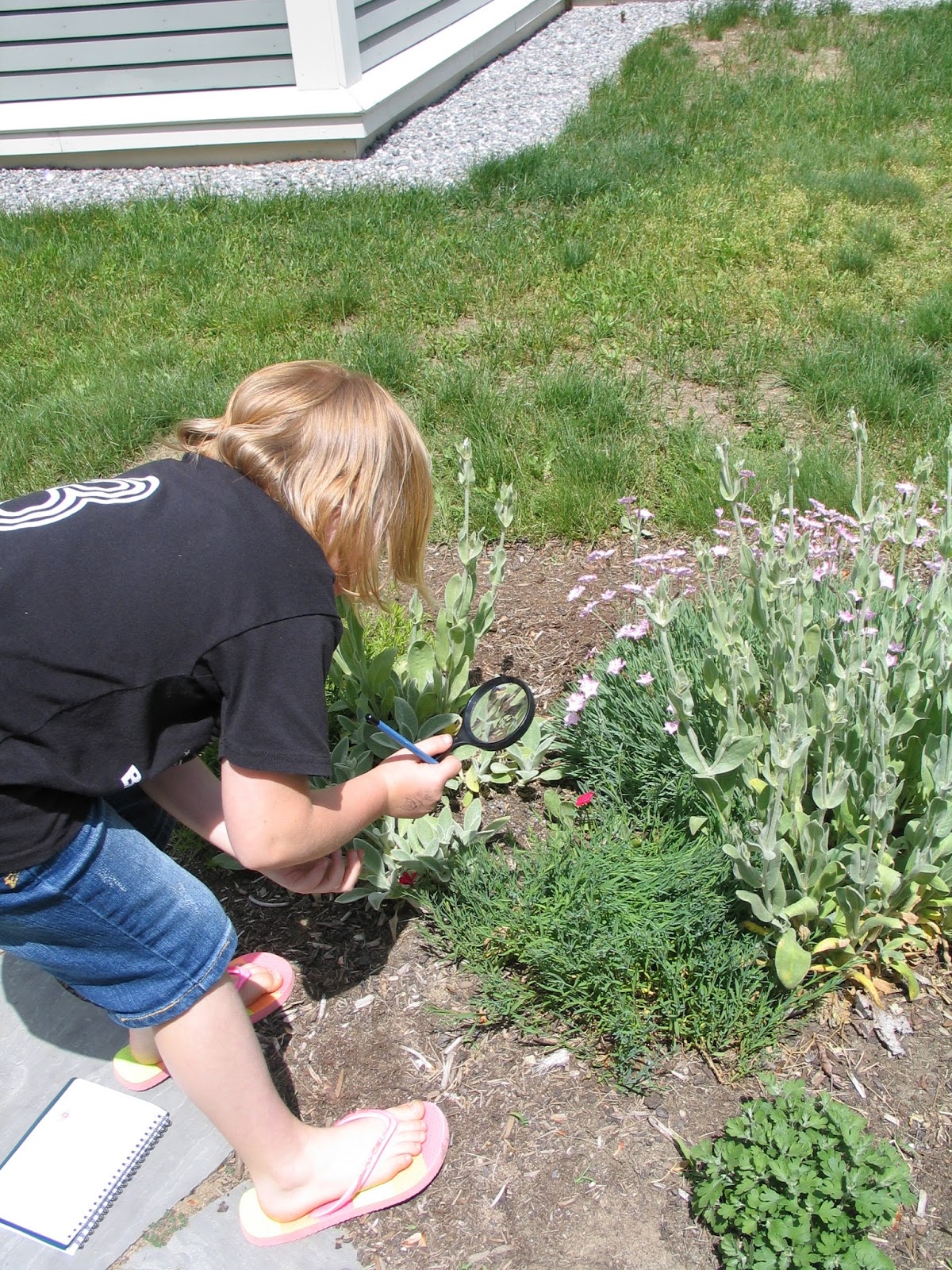
If you missed the Phenology Nature Journaling workshop and are interested in learning more, please check out our nature journaling resources page as well as our activity download page.
If you have tried any of our activities, we'd love to hear from you! Share with us how you used them, any suggestions you may have, or ideas for other activities.
Have a wonderful week!
Wednesday, June 12, 2013
Nature Journaling Workshop, Part II: Phenology
We are so excited about the upcoming nature journaling workshop! This is the second in our summer series and will focus on phenology. New to phenology? Don’t let the scientific-sounding word scare you. It’s really quite simple. If you’d like to read more about it before joining us, check out this post.
See you this Saturday, after the fishing rally, at 1:00!

Monday, May 20, 2013
Nature Journaling Photos and Resources
Here's a glimpse of our Intro to Nature Journaling workshop held this past Saturday:

Micro-worlds were unveiled, often overlooked details noticed with new eyes and excitement, and maybe even a new species of spider discovered!
Thank you to all who joined us. What a perfect it day it was to be out exploring the gardens!
P.S. We've created a new page on our blog dedicated to nature journaling resources. You are sure to find lots of useful information... Please be sure to check back regularly.
Remember, nature journaling is a practice to be done on a regular basis. The more you do it, the easier it becomes and will eventually become part of your routine. As our friend Roger says, "the longer you look, the more you will see" and the first step in understanding the natural world is to see.
Next workshops
Intro to Phenology, June 15th: Phenology is the observation and recording of the effects of seasonal changes on plants and animals. Join us to discover the joy and benefits of keeping a phenology journal.
Patterns in Nature, July 20th: You will be amazed at the patterns to be found all throughout nature and the influence they have had on the scientific, mathematical, and artistic worlds. Come see what patterns you can discover...
Monday, May 13, 2013
Monday Inspirations: Green
Hello again. Happy Monday. Are you looking forward to your week? We are definitely looking forward to our nature journaling workshop this Saturday. We sure hope to see you there...
Until then, we're here to provide a little inspiration for working some nature exploration into your week. We promise it'll be fun!
The following activities have been inspired by all the beautiful green growth outside as well as a lovely book titled Green by Laura Vaccaro Seeger. Whether you are 3 or 93 or somewhere in between, give them a try and have fun!

- Matching Green: Have you seen our color walk cards in the childrens' area? Would you like to have your own? Head to your favorite paint supplier and collect some paint chips. Try to choose shades of green close to what you have seen in nature. Punch holes in them and attach to a key ring. Head outside and see how many of them you can match.
- Creating Green: Put some green paint on a paint pallet or paper plate along with some white and black paint. Try slowly adding some white or black to the green and paint that color onto some paper. Now add a little more and add it to your painting. Experiment further by adding yellow, blue, and purple. What do your shades of green look like now? By the time you are done you'll have a lovely green color study that just might be fridge worthy.

- Journaling Green: Now that you've experimented with making different shades of green, take your nature journal and paint supplies or colored pencils outside. Stop at a few different plants, draw a quick sketch, maybe add a description, and try to match the color. You'll have captured the freshness of spring in your journal. Maybe you can even visit the same plant in the summer and see if the color has changed any...
If you would like to share photos of any of these activities that you have tried, we would love to see them! You might see them in a TPL Gardens photo gallery!
Friday, May 10, 2013
A Great Day and Another Coming Up...

Last month the Topsham Public Library Garden Committee hosted a Garden open-house and what a lovely day it was! The weather was perfect, volunteers were hard at work, children played, laughed and made some nature crafts and we even made a few new friends. We call that a success! Thank you to all who joined us.
This month, we have another fun event happening in the gardens and it's coming right up...
It's our second annual nature journaling workshop. This year, we will be hosting a series of three workshops, all with a specific theme.

The first in the series, taking place May 18th at 1pm, will be an introduction to the practice of nature journaling and is open to all ages. We’ll be kicking it off with a not-to-be-missed 3D slide presentation by a very special friend that's sure to inspire you. The rest of our time will be spent in the gardens where you'll receive individual guidance as you make a nature journal entry.

We will provide notebooks and sketching pencils, although do feel free to bring your own supplies. You may also choose to bring your camera if you’d like to add photos to your journal.
We hope to see you then...
P.S. If you'd like to read more about nature journaling, check out my post here: The Art of Observation
Don't forget to view the resources at the end.
P.S. If you'd like to read more about nature journaling, check out my post here: The Art of Observation
Don't forget to view the resources at the end.
Subscribe to:
Posts (Atom)